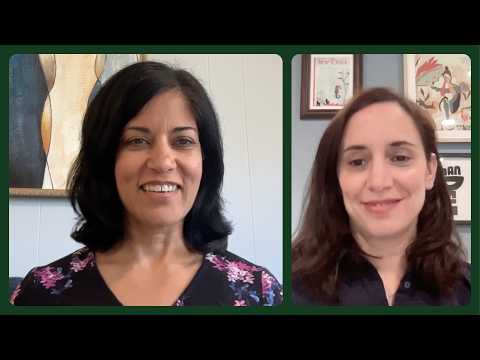
Tackling an Invisible Health Crisis for Young Children and Caregivers
Liz Schurgin is the Executive Director of the Greater DC Diaper Bank, where she has spent the past several years leading through uncertainty. While meeting rising demand with limited resources, Liz has focused on fostering resilient teams, strengthening partnerships, and finding ways to move forward when the stakes for women and families are highest.
Transcript
Rachel Mandell (00:00)
Today we're welcoming Liz Schurgin to have a conversation with us. We're excited to welcome her. She is the executive director of the Greater DC Diaper Bank. As a nonprofit leader, she is passionate about challenging systemic inequalities, utilizing creativity as a tool for change, and building strong teams and organizations. Prior to the Diaper Bank, Liz served as executive director of the DC Youth Orchestra Program. Under her leadership, the organization more than doubled its staff, board, and budget and tripled its reserves. She's also on the faculty of the University of Maryland, is a musician, improviser, and mother. Welcome, Liz, we're thrilled to have you.
Liz Schurgin (01:11)
Thank you so much for having me.
Rachel Mandell (01:13)
So we'll dive right in because there's a bunch of interesting things and topics going on in the nonprofit sector. This year, there's been a lot of change and uncertainty that some of us are aware of more than others, but especially for organizations that support women and families. Can you share a moment when an unexpected challenge came up over this past year and just talk to us about how you navigated as a leader?
Liz Schurgin (01:41)
Absolutely. This past year has been really an exercise in the unexpected. I stepped into this role in April 2024. I am helping transition the organization from its founder to its next chapter. And all I heard from the team was, we want stabilization. And then 2025 happened. And it seems that just about every month, if not every week, we're pivoting from one thing to the next.
Reflecting back on this past year and everything that we've had to navigate — it has been a difficult year for women and families. The Greater DC Diaper Bank is already addressing what we call a hidden public health crisis. We knew going into 2025 that nearly one in two parents and caregivers of young children struggle to access enough diapers to keep their child healthy and dry. That is known as diaper insecurity. You need diapers to put your kid into childcare and you need childcare to go to work or to school. Diapers are not covered by SNAP. They're not covered by WIC. And that's where the Greater DC Diaper Bank steps in. We work with a series of human and social service organizations in Maryland, DC, and Virginia to get these essential items — diapers and other baby essentials — to families that are experiencing need.
This past year was tough, in part because we work through a variety of partners. They were also experiencing everything that was going on. Over 80% of them reported that they have experienced an increase in parents and caregivers seeking services and support. And we live in Washington, DC. So we were directly impacted by the government shutdown. We are impacted by the changes in employment here. We rest at the highest unemployment in the nation right now. And that has a trickle-down effect into an organization like ours.
When I was reflecting on an unexpected challenge — we have reached the highest level that we experienced during the pandemic. Need is up and resources are down. So what do you do in this tension, this paradox of we are in service to our community, the community is hurting, and we have less to go around than what we historically have had? We did everything we could — appealing to different entities to see if we could get more corporate donations, more financial contributions. At the end of the day, we're not impermeable to the environmental trends and giving is down, especially in mid-level and low-level giving.
So we ended up having to make a tough decision. As we were planning for 2026, we knew the only thing that was certain was that it was going to be uncertain. We decided to really focus in on our mission and we elected to pause two of our programs so that we could have a greater impact with our main program. Every single one of our 80 partner organizations receives diapers from us. And they then pass those diapers on to parents and caregivers.
Over time, we had taken on a variety of other supports. We know that if you're experiencing diaper insecurity, you're three times more likely to experience hygiene product insecurity. So we had adopted a program that provided partner organizations with different types of hygiene products. But we had to make a tough decision. And if there's one thing I'm proud of, it's that working in a nonprofit, there are a lot of stakeholders. I'm not the sole decision maker. I make decisions in conjunction with the board of directors, with our team, with our partner organizations. We came up with a feedback loop where we connected with all of our partner organizations and asked what was really important to them. And we brought this to our team and to our board and said, look, diapers are the most important thing and we don't have as many resources as we've historically had. In a moment where the pull and desire is to do more because there is more need, we elected to focus our impact on what had the greatest outcome for our partners and by extension their families.
That was really hard. It was not something, if you would have asked me a year ago, I would have predicted. But we realized that moving forward, this is how we can continue to have the greatest impact and help and support more parents and caregivers in our region.
Rachel Mandell (07:53)
As you're reacting and adjusting to the changes that are going on and continually around the corner, I wonder if you could talk to us about keeping resiliency in your teams and your partnerships, especially in these really resource-constrained conditions.
Liz Schurgin (08:18)
So building resilience or keeping resilience — I have to say I came from the performing arts space when I stepped into the human services space. And the people who work in the human services space, I think by nature are incredibly resilient. You have to be. And we just came out of the pandemic, that shared trauma that put an excessive burden on the human services space. And here we are in an acute crisis mode.
In crisis, I've always framed my approach as shortening the runway a little bit. It's not so much lowering expectations, but rather celebrating smaller wins because it can be really hard to see the big picture when you're in the thicket of chaos. I think it's about celebrating the resilience that already exists in the team and acknowledging that the work we are doing is hard. It is emotionally draining at times.
Teams are the greatest resource that anyone has in the nonprofit space. Our greatest asset is our teams. And second to that is their time. We have to protect their time and show care towards their time and show care towards them. And myself included — I only have so much emotional bandwidth that I can give to this job and still take care of myself. And if I'm not taking care of myself, then there's absolutely no way that I'm taking care of my team. And by extension, the greater organization.
So we talk about how we can spend our time wisely, how when it's a tough day, it's okay to take a step away and breathe. Throughout the year we've been messaging — if you need space, if you need a moment to breathe, please take that. And I've done as much as I can to model that. When it's been an especially hard day, if there's a shift in policy or we had news that one of our partner organizations folded, being able to take a step, breathe and recenter is really important. Acknowledging that things are hard is part of how we keep the forward momentum.
We also shorten the runway. What was the one thing we're going to accomplish this week? Great. Let's celebrate that. We just did an exercise this past week where the whole team reflected on one thing they were proud of on behalf of the organization. And if I'm to summarize what our team came away with — they were really proud of how they showed up for our partners and by extension the families that they were serving, and that we were able to do this by taking care of ourselves and acknowledging and giving space to how hard this work is.
It is hard to live in a space and have the daily reminder that half of parents and caretakers out there are struggling with their basic needs. Becoming a parent for me was the hardest thing I've ever done and on a daily basis is still the hardest thing that I will ever do. And to think that there are so many people struggling with basic essentials is hard.
But the way I've framed it that has given me inspiration — the diaper bank is a reflection of the greater good of our community. We're all showing up, we're here, we're taking care of each other. The way we work is we take excess diapers from the community. Parents whose kid just grew from one size to the next — there is a whole network in which they can get those extra diapers to us. So we're showing up and we're taking care of each other. I lock into that on a daily basis. And as much as I model that and remind that to our team and they remind that to me — the thing about being in a leadership role is I learn just as much from the people that I have the privilege of working with as I hope that they would learn from me.
Rachel Mandell (13:49)
I think that point about also creating opportunities for people in the community to contribute is important. You're allowing folks who don't spend all of their time on a particular cause to at least contribute and feel like they are a part of the solution. In that vein, we're also in the DC area. We're in Northern Virginia. We feel the impacts of the shift as well. Many of our close friends are out of work still and are really looking for mission-driven work. They've left the government or a contractor for the government, and they have been focused on making an impact their entire careers. And they want to continue doing that in some capacity. A lot of them are looking to the nonprofit sector. I'm curious if you could speak to the qualities or skills that stand out most when you're hiring, or if you have particular advice for people trying to translate experience they've had into the nonprofit space.
Liz Schurgin (15:01)
Absolutely. One of the things I've learned working in this role in the nonprofit space, especially as someone who came from the performing arts space and now works in a human services organization, is that every space has its own language. So many people have wonderful skills and talents and so much of finding a job — I do believe there's a big amount of luck in it — but I also believe it's about being able to tell the story of what your skills and experiences are in the language of whatever organization or industry you're trying to transition into.
I think about our organization. We were fortunate to hire three positions this past year. All three people came from similar experiences, but not necessarily one to one. No one worked at a diaper bank before. No one worked at a food bank before. They were coming from related fields. And what made them successful is us understanding truly how what they've done in the past will translate into this space.
Working in a nonprofit, there is always some sort of consensus around decision making. The people who are the most successful are the ones who create or tell the story in a way that other people don't have to use their imagination. Making it so easy. And understanding that even though we are technically large by the way we distribute and our program reach, we are still very much a small shop and there are many times that you will have to roll up your sleeves and do things that are outside of scope of what might be traditional. What works really well in our organization is people who come with that spirit and energy.
What I will say is I had a good friend who was affected by the reductions in force that happened. Incredibly smart, incredibly talented. And it's a hard time to get a job in this region. We were talking about how all the research shows that volunteerism has a total positive effect on the individual. It correlates with higher happiness, having kind of other-orientation and being able to connect to other people. So I said, come in and volunteer at our organization. And it was really delightful to see how that gave her a sense of purpose while she was going through this job search, which was hard and grueling. We all celebrated when she finally got a job. And she was also able to see and get some perspective on what our organization looks like and how it functions.
If you're looking to make a transition into the nonprofit space and mission-driven work, I highly recommend going and volunteering at a variety of different organizations just to get a sense of how they function, what the culture is, really what the expectation is around their employees. Being as familiar as you can and gaining comfort that you know the space and the language of that space can help. We buy 10 million diapers a year. The concept and the terminology around procurement is not something that is readily used in our space. But the same concept, if you've worked in procurement in a different industry, say USAID — that is applicable. It's just we talk about it as wholesale purchasing. And that's just the language that's used in our space. Being able to say that your experience in procurement translates to what we're doing here at the Diaper Bank — that's an example of something that could help people who are looking to step into the nonprofit space.
Rachel Mandell (20:52)
I think this is incredibly useful. I wonder if there are any specific examples — if you're interviewing someone, maybe a good example or something where it would be useful for folks to hear what catches your attention when you're speaking to someone, in addition to the language.
Liz Schurgin (21:43)
Out of respect to everyone who I've had the privilege of interviewing this past year, I'll give a modified example. In the nonprofit space, even as the executive director, I have decision-making authority over a certain aspect of the organization, but any large strategic decisions are made in conjunction with the board of directors. I am not the main decision-maker when it comes to things that could have a profound impact, whether financial or physical, on this organization.
Recently I've had a lot of conversations with people where they talk to me as if I can make the decision and they want to know what my vision is. And I am very clear on what my vision is, but I am also very clear that I don't have the capacity to make that decision alone. Sometimes in the corporate world, the CEO or executive can make these decisions. You invest in a CEO because of their vision and the way that they make decisions to support that.
Knowing that that is a fundamental difference between the corporate world and the nonprofit space — that shows a level of informed perspective. And if someone understands to some extent how the board operates, which is incredibly important for a leadership role, that shows me a level of knowledge and sophistication. Even if they've never worked directly with a board of directors, the fact that they are aware that there are certain situations where we would need to tap into the board's expertise or rely on their decision-making — that shows me they are informed enough that this wouldn't be a culture shock.
That's the one thing I'm sometimes concerned about when hiring. I can see how smart this person is. I can see how capable they are. Their experience is amazing. I want to make sure even though it is not necessarily my space, that I'm aware of what their learning curve coming in is. I think it's a general familiarity and understanding that things work and operate somewhat differently, especially in the small-to-mid-sized nonprofit space. That sometimes helps me have confidence.
If it's an entry-level role, sometimes it's just saying, this is my experience and this is how it's applicable. But I think it's really about painting a picture of what would I look like in this organization and not relying that the other side has perspective and the same imagination. I walked into the human services space as a performing arts person. I had to be able to translate the stories of how fundraising for a youth orchestra is translatable to fundraising for a human services organization. It was on me to paint that picture in a way that was easy to understand.
Rachel Mandell (26:57)
I think that's really useful and worth spending time working on — how to demonstrate that you have thought about how your skills translate. To pull a little bit more on your musical background — you're on the front lines. You're really delivering necessities to women, to children. And at the same time, a lot of the higher-level things going on in the world — you exist because certain systems just aren't working. How do you navigate that as a nonprofit leader between the high-level systemic issues and actually executing on the ground day to day?
Liz Schurgin (28:10)
That is a great question, one that I am tackling right now, because I truly believe if you don't know a problem exists, then how are you going to fix it? Most people who haven't had the lived experience of diaper insecurity are surprised to hear that it is in fact real and as prevalent as it is.
Diaper insecurity has existed for a long time. It was really during World War II that disposable diapers took off and for a while they were a thing of privilege. And then when women started entering the workforce more in mass during the women's liberation movement, you started to see the necessity of disposable diapers because it's easier for childcare providers. All of a sudden, disposable diapers went from being a luxury to a necessity. And interestingly enough, in certain situations now, cloth diapers are considered a luxury because you need access to the right type of equipment or service to clean them.
We're in this moment right now where we are addressing something significant. There's a childcare crisis in this country. There's a maternal health crisis. We touch all of these aspects. Pay equity is still not where anyone in this community would hope. And period product insecurity goes hand in hand with diaper insecurity — one in three teens in our country don't have access to enough menstrual products. If you are experiencing period product insecurity, you are more likely to miss school. It's so perpetuating.
What we're doing to overlap working on the front lines and raising awareness is to really find groups and organizations doing adjacent work and tap into the network and do a small amount of education. On an operational level, for example, volunteering — we need volunteers to turn around those diapers. A million of our diapers come in through the community and that's 3,000 volunteer hours. So we look to partner with organizations already working in this space — parent and teacher associations, Girl Scout groups, corporations with family resource groups. Anything already working in the maternal health space, women's leadership, pay equity, we connect with them and try to connect the dots.
We also address that on a policy level. It's all interrelated, like so many things we're trying to address. My role this year is really to step out and add a little bit more voice to this within the framework of our own community. One of the things we found is there wasn't really a network of all these human service organizations that brought them together because they all serve babies. We have reentry programs, healthcare programs, community health organizations, religious organizations that weren't really talking to each other. We're starting to think about and pressure test — what is the role that the Diaper Bank has and by extension, what role do I have? Right now, I really see myself as a connector, connecting people to this hidden public health crisis and raising awareness and finding groups that are already invested in the work we do, but just don't know that this exists.
Rachel Mandell (33:49)
That feels like an excellent path forward in uncertain times — connecting more community and people who are focused on similar if not the same issues. Well, this was excellent. Thank you so much for your insight. Where can people find you and learn more about the Diaper Bank?
Liz Schurgin (34:16)
To learn more about the Diaper Bank, you can go to our website, www.GreaterDCDiaperBank.org. You can also find us on all of the social platforms. You can find me on LinkedIn or find my email address on the website and reach out to me. I'm pretty accessible on that front and always looking for ways to connect.
Rachel Mandell (34:42)
Thank you for joining us and thank you for your service for our community. We really appreciate it.
Liz Schurgin (34:47)
Thank you. It was wonderful to speak with you both today.